

The dark web is a secret, sometimes dangerous or illegal place. When cryptocurrency Add into it, the curiosity grows. But what is actually happening when people talk about cryptocurrency on the dark web?
This article breaks down the real story behind cryptocurrency on the dark web, why it is used, what risks are involved, and whether it is untraceable or not.
How Does Cryptocurrency Fit In the Dark Web
The dark web is a hidden part of the internet that is not indexed by regular search engines like Google. You need special software, like Tor Browser, to access it. While the dark web itself is not illegal, it has become linked with illegal marketplaces, forums, and services because it offers a high level of privacy.
This is exactly where cryptocurrency on dark web activity comes in. Payment methods like credit cards or bank transfers leave a clear paper trail. However, the Cryptocurrency move money without revealing your identity, banking details, or physical location. That single feature made it the preferred payment method on the dark web almost from the very beginning.
Why Cryptocurrency on Dark Web Became So Popular
Cryptocurrency is widely used for transactions on the dark web. Take a look at what buyers and sellers in these hidden marketplaces actually need.
Anonymity and Pseudonymity
Cryptocurrency wallets are not directly secured to your name the way a bank account is. Instead, they use long strings of letters and numbers. This pseudonymous nature made it attractive for people who wanted to avoid leaving obvious identity clues.
Decentralization Appeals
Cryptocurrencies are not controlled by a single bank or government. So there is no central authority that can freeze an account or reverse a transaction. For dark web marketplaces, this decentralized structure meant transactions could happen without needing approval from any financial institution.
Global Reach Without Borders
You can transfer assets anywhere in the world with crypto. A buyer in one country and a seller in another can complete a transaction in minutes, something that would be far more complicated and traceable using traditional banking systems.
Which Cryptocurrencies Are Used on Dark Web Marketplaces
When it comes to cryptocurrency on dark web transactions, not all digital coins are used equally. Some are more common than others because of their features.
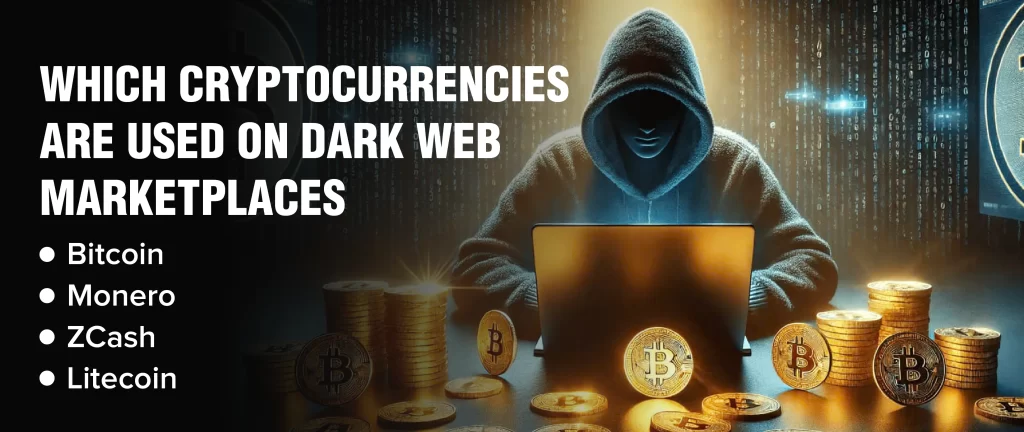
Bitcoin (BTC)
The original and most widely accepted cryptocurrency. Bitcoin transactions are recorded on a public ledger and are traceable with the right tools.
Monero (XMR)
Monero is also known as a privacy coin. It hides transaction details like sender, receiver, and amount. This makes it harder to trace than Bitcoin. It has become a favorite for cryptocurrency on dark web dealings.
Zcash (ZEC)
It offers optional privacy features that shield transaction data, giving you a choice between transparent and private transactions.
Litecoin (LTC)
It is used as a faster, cheaper alternative to Bitcoin for smaller transactions.
The Risks Involved in Cryptocurrency on Dark Web Use
Cryptocurrency on dark web transactions look convenient, but they come with serious risks that are often ignored.
Legal Risks
Using cryptocurrency to buy illegal goods or services has the same legal consequences as any other illegal transaction. Law enforcement agencies worldwide focus on cryptocurrency tracing and being involved in illegal marketplaces. It can lead to criminal charges, regardless of the payment method used.
Scams and Exit Scams
Dark web marketplaces are not regulated. There is no customer service line to call if something goes wrong. Many marketplaces have vanished overnight with users’ assets still sitting in escrow. It is known as an “exit scam.” Buyers have no option when this happens.
Malware and Phishing
Fake wallets, cloned marketplace links, and malicious downloads are common on the dark web. When you are searching for information about cryptocurrency on the dark web and visit the wrong link, you can accidentally expose your device to malware.
Price Volatility
Cryptocurrency prices can blow dramatically within hours. This adds an extra layer of risk for anyone using it as a payment method. The value of funds sent can change before a transaction is even completed.
Scams Involving Cryptocurrency on the Dark Web
Scams are one of the biggest dangers of cryptocurrency on the dark web. They come in far more forms than most people expect. As there is no customer support, no refund policy, and no regulator watching over these marketplaces, scammers have plenty of room to work.
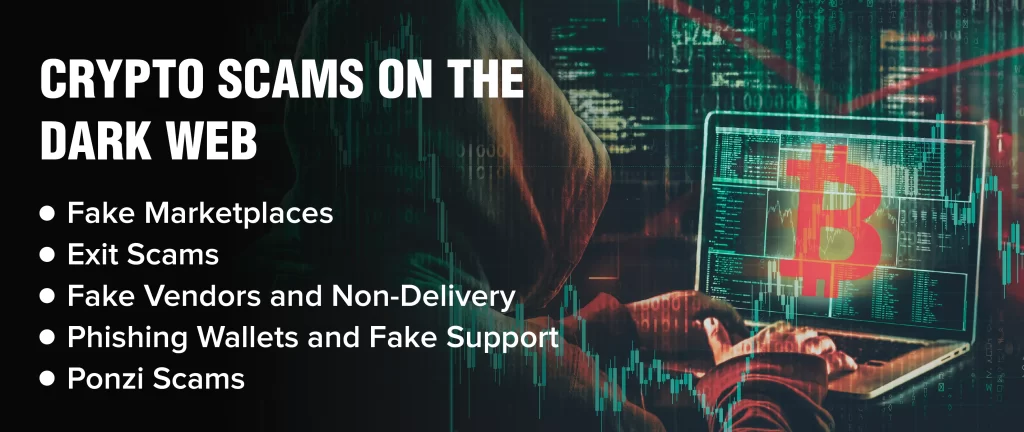
Fake Marketplaces and Cloned Sites
Scammers create copycat versions of popular dark web marketplaces. These fake sites look similar to the real ones but are designed to collect payments and disappear. Anyone searching for cryptocurrency on dark web platforms can easily move on one of these clones without understanding it.
Exit Scams
This is one of the most common tricks in dark web history. A marketplace builds trust over months, collects funds in escrow, and then vanishes overnight. They take the crypto of every user. Since there is no legal way to report the robbery, victims are left with nothing.
Fake Vendors and Non-Delivery
Some sellers accept cryptocurrency on dark web marketplaces, take the payment, and never deliver the goods or services. Since buyers can’t verify the real identity of a seller, there is no way to hold them accountable afterward.
Phishing Wallets and Fake Support
Scammers frequently pose as wallet support teams or marketplace admins, tricking users into revealing private keys or seed phrases. Once a scammer has this information, they can drain a wallet within minutes, and the transaction can never be reversed.
Ponzi and Investment Scams
Some dark web forums promote fake investment schemes promising guaranteed returns on cryptocurrency. These operate exactly like traditional Ponzi schemes, using new investors’ money to pay earlier ones, until the scheme collapses.
Protect Your Crypto from Dark Web Threats
Given how common scams are, protecting your crypto from dark web threats should be a priority for anyone who interacts with digital currency, even outside of dark web contexts. A few simple habits can make a significant difference.
Use a hardware wallet
Storing funds offline in a hardware wallet keeps them out of reach from phishing attempts and malware that target software wallets.
Never share your seed phrase
No legitimate support team will ever ask for your private key or recovery phrase. Sharing it is the same as handing over your funds.
Enable two-factor authentication
Adding an extra security layer to exchange accounts and wallets makes it much harder for attackers to gain access.
Avoid clicking unknown marketplace links
Many phishing attacks start with a fake link claiming to lead to a trusted dark web marketplace.
Double-check wallet addresses before sending funds
Malware is known to swap copied wallet addresses with a scammer’s address, redirecting funds without the user noticing.
Keep software and antivirus tools updated
Outdated systems are far more vulnerable to malware designed to steal cryptocurrency.
Research before trusting any platform
If a platform related to cryptocurrency on dark web activity promises unusually high returns or guarantees, treat it as a red flag.
How Cryptocurrency Transactions Work on Dark Web
The process behind cryptocurrency on dark web purchases is not as complicated as you think. Here’s a simplified breakdown of the typical steps:
- A buyer creates a cryptocurrency wallet, often using a new or “clean” wallet address.
- Funds are purchased through an exchange or converted from another source.
- The buyer sends cryptocurrency to a marketplace’s escrow wallet.
- The seller ships the product or delivers the service.
- Once confirmed, the marketplace releases funds to the seller, minus a commission.
Escrow systems are common because they reduce the risk of scams between anonymous parties who have no other way of verifying trust.
Law Enforcement and Blockchain Tracing
One of the biggest misconceptions is that cryptocurrency dark web transactions are completely anonymous and untraceable. In reality, blockchain technology creates a permanent public record of transactions for coins like Bitcoin.
Law enforcement agencies now use advanced blockchain analysis tools to trace transaction patterns, link wallet addresses, and identify individuals behind illegal activity. Several high-profile dark web marketplace shutdowns in recent years happened specifically because investigators were able to follow the money through blockchain records, despite the criminals believing they were untraceable.
This is why many dark web users have shifted toward privacy-focused coins. Even then, mistakes in operational security, such as reusing wallet addresses or linking crypto wallets to identifiable accounts, have led to arrests.
Frequently Asked Questions
Is cryptocurrency illegal on the dark web?
Cryptocurrency itself is not illegal. However, using it to purchase illegal goods or services on dark web marketplaces is against the law in most countries.
Can police trace cryptocurrency transactions on the dark web?
Yes. Many cryptocurrencies, especially Bitcoin, work on a public ledger that can be analyzed using blockchain forensic tools, allowing investigators to trace suspicious activity.
Is Monero completely untraceable?
Monero offers significantly stronger privacy compared to Bitcoin; no system is entirely foolproof. User mistakes and advanced forensic techniques can still expose activity.
Why do people prefer cryptocurrency over regular payment methods on the dark web?
Because it offers a level of pseudonymity, isn’t controlled by banks, and allows transactions across borders without the usual paperwork or approval process.
Conclusion
Cryptocurrency on dark web platforms became popular because of the privacy, decentralization, and global accessibility it offers. However, the idea that it’s completely untraceable is a myth. Blockchain analysis, law enforcement tools, and simple human error have exposed countless individuals who assumed they were operating anonymously.
Understanding how cryptocurrency dark web transactions work helps separate fact from fiction. At the same time, it’s a good reminder that cryptocurrency, as a technology, has far more legitimate uses than illegal ones. The real story isn’t about secrecy; it’s about how digital currency continues to reshape the way value moves across the internet, for better and worse.




What do you think?
[…] is an anonymous cryptocurrency hardware wallet that stores private keys separately from internet-connected devices. ShipMonk is […]