

When you hear the word DEEP WEB, you instantly think hackers, illegal market, and black market. But here is the truth: you probably go to the deep web this morning. When you log in to your Gmail, check your online banking portal, or open your Netflix account, you are browsing the deep web.
This guide explains what the deep web actually is and how it is different from the dark web.
What Is the Deep Web?
The deep web is a part of the internet that is not indexed by standard search engines like Google, Bing, or Yahoo.
So, if Google can’t crawl it and list it in search results, it is part of the deep web.
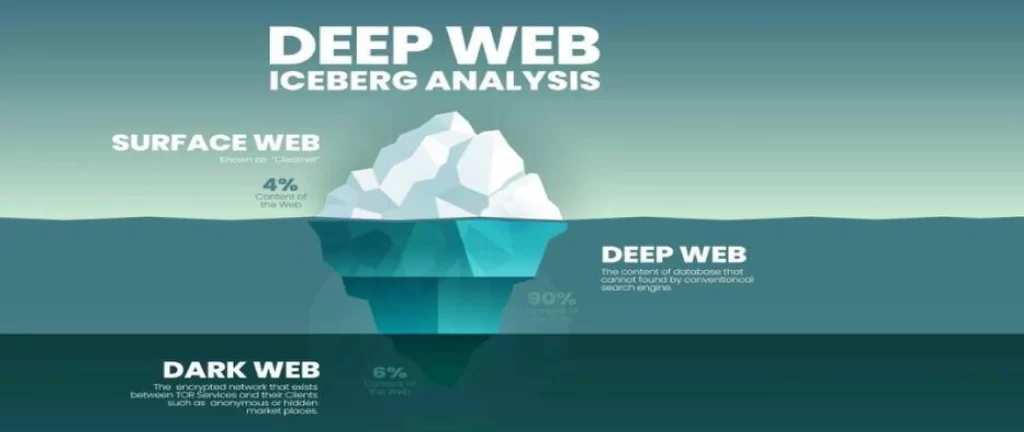
The internet is like an iceberg, and the part above the water. Websites you find on Google searches, social media links, and news articles are included in the surface web or Clear net. It is publicly accessible and searchable.
However, everything below the waterline is the deep web. It is huge and almost 400 to 500 times larger than the surface web. Researchers say that it includes more than 7,500 terabytes of data. While on the surface web, there are roughly 19 terabytes of data available.
Most of the deep web data isn’t criminal activity. It is a patient portal of a doctor, the internal research library of your university, or the private HR database of your company.
Why Does the Deep Web Exist?
The deep web exists because not everything is meant to be public online.
Suppose Google indexes your bank statements. Or your private medical records. Or private corporate emails.
So that is where the deep web arrives. It is a privacy layer baked into how the internet works. Content sits behind authentication walls, paywalls, or dynamic generation systems that search engine bots simply can’t access.
Here are the main reasons why content exists on the deep web.
Login Requirements
If a page requires you to sign in before browsing its content, it is a part of the deep web. It includes your Facebook feed, your Spotify library, and your online banking dashboard.
Paywalled Content
platforms that require subscription, like academic journals, news archives, or streaming services. These sites keep their content behind payment walls. Search engines can’t index what they can’t access.
Dynamically Generated Pages
Some websites create pages on the fly based on user queries. like flight search results or e-commerce filter pages. These are not saved as fixed URLs, and search engines can’t crawl them.
Private Databases
Government databases, corporate intranets, hospital records systems, and university research archives are all also the part of the deep web. They intentionally keep their data from the public eye.
Intentionally Non-Indexed Content
Some websites use a “robots.txt” file to tell search engines to stay away from certain pages. It’s their choice, often for legal or privacy reasons.
How Search Engines Decide What to Index
If you understand the deep web, it helps to know how search engines work. Here we make it simple for you:
When Google wants to index a webpage, it sends out automated bots called “crawlers.” These crawlers start with a list of known websites, follow every link they find, and record what is on the page. This data gets stored in a massive index on the public internet, Google.
If a page is indexed on the Google search engine, it means it is:
- Publicly accessible, and there is no login required
- Someone needs to link to it (or it needs to be submitted)
- It is crawlable and not blocked by robots.txt or other technical barriers.
- The content is static or constantly available.
So, if a webpage fails in one of these criteria, it ends up on the deep web. That is why the majority of the web content on the internet never appears in a Google search.
What is Actually on the Deep Web?
Now you know that the deep web is not a scary underground marketplace. Let’s have a look at what you will actually find here.
Academic and Research Databases
Universities and research institutions store huge amounts of data on the deep web. JSTOR, PubMed, and LexisNexis are deep web resources packed with millions of academic papers, medical studies, and legal documents. Most of it is only accessible to students, researchers, or subscribers.
Government Records and Databases
Census data, court records, law enforcement databases, immigration records, and governments around the world maintain massive repositories of information on the deep web. Some of it is accessible with the right credentials; much of it is strictly internal.
Healthcare Portals
Your electronic health records, lab results, prescription history, all of this lives on the deep web. Patient portals like MyChart are intentionally walled off from public search to protect your privacy.
Financial Systems
When you log into your bank, you are entering the deep web. Your transaction history, investment portfolios, and credit card statements are not indexed by Google, and for understandable reasons.
Corporate Intranets
Large organizations maintain internal networks for employee communication, document sharing, and project management. These private intranets are completely off-limits to search engines.
Private Social Content
Even platforms you think of as public have deep web layers. Your private Facebook messages, direct Instagram messages, and unlisted YouTube videos all live in the deep web.
Cloud Storage
Your files in Google Drive, Dropbox, or iCloud are not set to public. Your personal photos, work documents, and shared folders are included in the deep web without appearing in any search index.
What is the Dark web?
The dark web is a hidden part of the internet. It is not indexed by standard search engines like Google or Bing. It exists within the deep web network and includes all online content you can’t access through regular browsers.
However, the dark web has a dual nature.
On one hand, it serves legitimate purposes:
journalists communicate with whistleblowers, activists bypass government censorship, and privacy-conscious individuals escape surveillance.
On the other hand, it serves a significant illegal activity:
black markets trading in drugs, stolen data, counterfeit currency, and hacking tools. Cryptocurrencies like Bitcoin fuel these transactions because of their pseudo-anonymous nature.
Deep Web vs. Dark Web
The deep web and the dark web are not the same thing. The dark web is a small part of the deep web.
It is like you are saying all squares are rectangles. But not all rectangles are squares.
Just like that, all dark web content is on the deep web, but most deep web content has absolutely nothing to do with the dark web.
Here is the breakdown of dark web and deep web features:
| Features | Deep Web | Dark Web |
| Requires a special Browser | No | Yes with Tor |
| Accessible to the public | partially | With tools |
| Examples | Gmail, Netflix | Hidden forums |
| Legal | Yes | Yes, but some no |
The dark web requires a special browser called Tor (The Onion Router) to access. Websites on the dark web use “.onion” domains that don’t exist on the regular internet. It’s designed for anonymity — and while that anonymity does attract illegal activity, it also serves whistleblowers, journalists, and people living under oppressive regimes.
The deep web, by contrast, you access every single day using Chrome or Safari.
Examples of Deep Web Use That You’ve Probably Done
Still not convinced you’re a regular deep web user? Here are some examples that might hit closer to home:
- Checking grades on your school’s student portal
- Filing taxes through an online government portal
- Reading your lab results through a hospital patient portal
- Collaborating on a document in a shared Google Drive folder
- Watching a private video your friend sent you via a private link
- Accessing your company’s internal wiki or Slack workspace
- Managing your investments through an online brokerage
These activities are not shady. They are everyday tasks, and how we use the internet.
The Deep Web and Privacy
The deep web is not a flaw in the design of the internet; it is a feature.
Privacy is everyone’s right. Your private medical conversations with your doctor, confidential communications with your lawyer, and secure access to your financial accounts without that information being publicly searchable are something most people consider essential.
And the deep web makes that possible.
- Privacy advocates talk about protecting user data,
- When healthcare companies talk about HIPAA compliance
- Banks talk about secure customer portals
They are all talking about systems that live on the deep web by design.
The internet without a deep web will be like a surveillance nightmare where every login page, private message, and medical record is potentially indexed and discoverable by anyone with a search engine.
So, The Deep Web Is Just the Internet You Don’t See
The deep web is not a place. It’s not a community. It’s not a criminal underworld. It’s simply the part of the internet that search engines don’t index, and that turns out to be most of the internet.
It’s where your private data lives. It’s where your bank keeps your statements. It is where your doctor stores your health records. It’s where every authenticated, paywalled, or dynamically generated web experience lives.
Next time someone brings up the deep web in a quiet, dramatic tone, you can smile knowingly. Because now you understand that you have been browsing it comfortably your whole online life, you just did not have a name for it.
The internet is a lot bigger than what Google shows you. And the vast majority of that hidden space is doing exactly what it’s supposed to do: keeping your private life private.
How to Ensure Your Safety on the Deep Web?
- To be careful, you should use strong and different passwords for each account.
- Set up 2FA on accounts at your bank, certain emails, work systems, and as many services as possible.
- Always remember to change your password for accounts from time to time.
- Make sure to keep your browser, operating system, and security software fully patched with existing updates.
- Using a good antivirus will help you avoid being at risk of any online threats.
- Block or deactivate plugins that are not needed, turn on ad blockers, and use a browser with improved privacy features.
- Before logging into any account, double-check that you are on the authentic site before entering your identification.
- Use a secure connection before entering any login credentials or any data.
- Be cautious of any emails or messages that request data like your login credentials or personal information, even if they do not look suspicious.
- If you don’t know the source of a file, even if it looks authentic, do not download it from the Deep Web.
Frequently Asked Questions
Q: Is the deep web illegal?
Ans: No. The deep web is legal, and it is something you use every day. Checking your email, logging into online banking, and accessing your Netflix account are all included in the deep web activities. However, the confusion comes from people mixing up the deep web with the dark web. Illegal activity is more commonly associated with the dark web, which also hosts legitimate content as well.
Q: Can I accidentally end up on the deep web?
Ans: You are on it right now — or at least, you visit it daily. Anytime you log into an account online, you’re technically accessing the deep web. There’s no accidental “falling into” a dangerous zone.
The dark web, on the other hand, requires you to deliberately download and install the Tor browser and navigate to .onion addresses. It’s not something you stumble into by mistake.
Q: Do I need special software to access the deep web?
Ans: No. You access deep web content every day with your regular browser. You only need valid login credentials for whatever platform you are accessing. Your username and password for Gmail, your bank’s login, your streaming service account, etc.
Software like Tor is required to access the dark web, not the deep web.
Q: Is the deep web dangerous?
Ans: The deep web is not dangerous. It is the backend of the internet, the part that holds private, authenticated, or non-indexed content. Using your bank’s online portal or your university’s research library is perfectly safe.
Risk on the internet generally comes from human behavior, phishing attacks, weak passwords, clicking suspicious links, and not from the concept of the deep web itself.